Showing posts with label galleries. Show all posts

05 March, 2012

How we test the Life Online gallery exhibits

Blogger: Catherine Elvin, Audience Researcher and Advocate

My role in the Life Online team is to find out how our visitors react to each element of the galleries, and to look for ways that we can improve their experiences. I go out and talk to our audiences, with the aim of discovering what they find interesting and engaging, and what might be confusing or difficult to understand.

AudienceTesting

One of the best things about my role is that I get to work with everybody on the team, and see how things are progressing with all areas of the project, from the exhibitions and galleries to the websites and workshops.

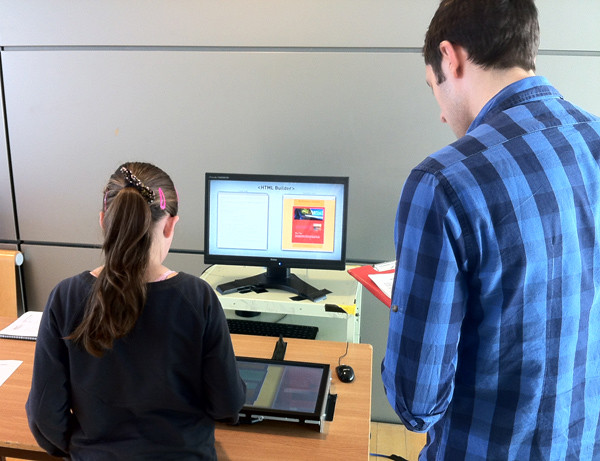
One of the largest areas of work for Life Online has been testing the new interactive exhibits with visitors. I've been involved all the way along in developing these exhibits, and my team are currently doing some testing with working prototypes.

For the Life Online gallery, all the interactive exhibits are touch-screen, computer-based exhibits. They look at very different elements of the history and use of the internet; how the internet has replaced older technologies; what the early web looked like; how online businesses have succeeded and failed. The prototypes aren't always finished exhibits - usually we'll be wheeling a computer around on a trolley - sometimes it will just be an idea explained using a slide show or on paper.

We ask visitors to have a go at the exhibit, and imagine they've just encountered it in a gallery, then we ask some questions to ascertain what they particularly liked about it and which bits still need work. When we've collected a range of different opinions about the exhibit, we talk to the design team about what they can do to improve the exhibit based on that feedback. This can be anything from making the key messages clearer, to changing where buttons are on the screen to make a game more intuitive to play.

We've nearly finished working on the interactive exhibits, and it's exciting to see everything coming together as we get closer to the final install date.

29 February, 2012

Creating films for Life Online

Blogger: Emma Shaw, Media Developer

Getting the opportunity to work on a brand new gallery doesn't happen very often, so when work began on Life Online and we found out we were going to make video content for it, we were very excited.

Creating videos for a gallery is fun, because you get to learn about the subject, film interesting people, and come up with creative ways to explain people's ideas in films that can be as short as one minute! We've learned a great deal about the history and development of the internet from the Life Online team, and we've had the chance to work with the founders of the internet, the people whose ideas created the online world we know today.

One man we had the pleasure to film was Vint Cerf, who not only co-created the foundations for the internet back in 1973, but inspired the character of 'the architect' in The Matrix Reloaded movie... what greater accolade?

We met him in a small meeting room in Oxford while he was in the UK attending a debate about the future of the internet. He gave us his time for free, waited patiently as we set up the camera, answered all our questions (intelligent technical ones from Life Online curator Tom, and less intelligent ones from me, "can you tell us, again, about the time when you turned OFF the internet?") and even though we overran our allocated time, he stayed with us to make sure we had everything we needed. He is one of the nicest men I've ever met. You can see him in films all around the galleries, explaining how it all began.

VintCerf

We also recorded some interviews over Skype, with legendary figures such as Ray Tomlinson, who is credited with being the inventor of email. He told us about sitting in his office late one evening, acting upon an idea he'd had to send electronic mail between computers. In that moment he effectively changed the way we all communicate today - can you imagine life before email? When he achieved this, it was so late in the evening that the building was empty, so he didn't even have anyone to tell!

RayTomlinson

There were some creative challenges, like how to explain what TCP/IP is, in a way that we could understand ourselves. Our in-house animator Sven Shaw came to the rescue and created some beautiful animations which show how TCP/IP enables pockets of information to be carried along the networks, like pigeons carrying mail, effectively allowing information to flow freely and efficiently across the networks. You can see the full film in the gallery.

Want to know how a search engine works? Find our in the gallery, with the help of our friendly web crawler spider.

WebCrawler

It's not all been hard work. We've enjoyed watching old technology programmes from the 1980s which announced great innovations such as the floppy disk, and computers which could connect to a network via the telephone (if you have a few hours to wait), so people could talk to each other online for the very first time.

It's amazing to be a part of the Life Online team, and we hope you enjoy watching our videos as much as we enjoyed making them.

Your own videos can be a part of Life Online too. Visit www.nmemlol.wordpress.com and take part in missions for the Your Life Online Project.

22 February, 2012

"System Overload" youth project ready for Life Online [open source]

Blogger: Dave Smith, Life Online Youth Engagement Officer

Six months ago, a group of dedicated young people came together to work on the development of a brand new artwork as part of the Life Online project. Here we are in February and the fruits of their labours have just been installed in the Level 7 gallery, as a piece called System Overload. So, how did we get here?

IMG_0913


It all began back in September. A month earlier the group had voted to make an animation about net neutrality and with the help of artist Jack Lockhart they embarked on a series of workshops and activities. The aim: to learn how to animate and how to make cool art.

The first thing the group did was create a visual language to use, playing with concepts, ideas and techniques, working out how to represent abstract things like "the internet" as interesting animations. The results were three animation techniques: stop-motion, lightwriting and pixilation, and some ideas about where to go next. The group also researched the net neutrality and started to have ideas about why it's an important topic and what they wanted to say about it.

IMG_0907


The next item on the agenda was to develop a structure for the artwork. As the piece was going in a gallery we didn't want a projection onto a wall, not when there was the chance to make something more interesting. As the group talked, the idea of using nodes and lines developed, and we combined this with experiments in projecting onto 3D objects like boxes. The result was a pattern, to be cut from wood and hung in the gallery: the animations would be projected on this later on.

With the structure in place we got on with animating. Led by our "meme master" Callum, the group started to create phrases and animations that explored net neutrality in the language of the internet: - Lolspeak (a language beyond us adults!)

IMG_0928


The project hasn't been all slaving over a hot camera: the group took a trip to Liverpool to see work on display at Tate Liverpool and FACT, examining what was good and bad about artworks and how they were displayed (and we've also had some great pizza...)

Slowly, the work came together over the autumn and winter and by the end of 2011 we had a bank of animations ready to assemble into one artwork. The final theme and name of the piece (System Overload) and a name for the group (Networked) were all worked out in January and added into the final display you'll see in the gallery. The last touch was to head to Factory Street Studios to compose a soundtrack to help create the mood we wanted.

Last week was the most exciting so far, as the group, Jack and the technicians gathered in Level 7 gallery to install the work. There were a couple of little issues but it was a generally smooth process and System Overload is now on the wall and ready to go when the gallery opens to the public on the 30 March 2012.

Later in the afternoon the local press were invited to see the work and meet the group – it was their first press event and despite having to be photographed from all angles and give soundbites they did really well.

IMG_0941


So, what's to come? The group are going to be spending the next couple of weeks working on some other creative projects, and then the gallery opens. If you want to learn more about the process why don't you come along to the Breakfast with the Artists event or visit Life Online [open source] from the 30 March to see the work in the gallery.

10 February, 2012

Curating the Internet for Life Online

Blogger: Anna Ward, Content Developer

Seven weeks to go before Life Online opens to the public. The physical build is coming on, looming shapes have appeared in the foyer, and upstairs in Level 7, walls are appearing. Our technicians are ready to fit screens, lights and speakers, and the office is a hive of activity.

Behind the scenes at this stage, everything needs polishing and signing off. There are bits of text to finish, films to check, interactives and animations to be tested and improved, and content still to collect. We are liaising with external agencies about design, animations and games, and with artists about their installations in our temporary exhibition upstairs. All the while we are talking to the press and helping our marketing and PR teams to get the message out about the gallery.

In short, we're busy!

There is one area which still needs a lot of work, but when I describe it, you won't think it sounds like work at all.

Cloud Browsers


At the centre of the gallery there are three large projection zones. In the office we have been referring to these areas as the 'Cloud Browsers'... a meaningless name which has its routes in a long forgotten concept. They are Find Out More stations, with a twist. Because our gallery charts the history and impact of the internet, we need to represent the internet within the gallery. But of course, we cannot allow free and open access, especially not when someone's search results will be projected six feet high for all to see; so starts the job of curating... the internet!

Our Find Out More stations (the name is still up for debate - any suggestions welcome!) will expand on the topics explored elsewhere in the gallery. In them you will find articles produced by our curators, films made by our in-house media development team, and lots of relevant content streamed live from the internet. Hundreds of websites need to be found, checked for accuracy and interest and added to the relevant section in the Stations. For the next seven weeks I am paid to surf the web! Better get back to it...

22 July, 2011

Art in Yorkshire iPhone app - Supported by Tate

We recently contributed to the Art in Yorkshire iPhone app - Supported by Tate, and we're pleased to announce that it features in the iTunes app store as 'New and Noteworthy'. A well-deserved success!

The app is a guide and interpretive tool for exhibitions and events taking place in museums and galleries throughout Yorkshire.

You can browse exhibitions, artists, venues and themes, recommend with a like, share with your friends, and find the code at the venue to leave your appinion (love this!)

It is an absolute pleasure to use. But don't take my word for it - here are some of the reviews on iTunes:

"I used this at the Yorkshire Sculpture Park... Fantastic app, really well put together with loads of info. If you like art, you'll love this!"
This app is extremely well designed. Great for finding details and reviews of art exhibitions in Yorkshire. I would love for this platform to be expanded to cover the whole UK. Great work!"
"Great little app: easy to use, loads of info, and smashing design. Just a shame there aren't more Appinions about. Love to unlock more of that content!"

Congratulations to Axisweb who developed the app in collaboration with fuse8, and in partnership with Leeds Met Gallery & Studio Theatre.

Art in Yorkshire Supported by Tate is a year long celebration of the visual arts in 19 art galleries throughout Yorkshire.

21 February, 2011

TV Heaven Welcomes TV's Most Famous Sheep

Blogger: Claire Hampton, Assistant Curator of Television

It's that time again - after the usual post-Christmas lull, the school holidays have kicked things up a notch. Assistant Curator of Television, Claire Hampton, has been busy preparing our TV galleries for half term visitors with a new addition to the display cabinets - television's most famous sheep.

Claire in TV Heaven

"We've spent the last year celebrating the numerous soap anniversaries which took place in 2010: 50 years of Coronation Street in TV Heaven, a visit from the cast and crew of Hollyoaks, and there was even a display commemorating 25 years of EastEnders.

"Unfortunately the Museum's year of soap has come to an end. It's time to carefully pack up Arthur’s bench of tears, Bianca’s wedding dress and Sonia’s trumpet and return them to the EastEnders' prop and costume department. All the items will now be carefully returned to Elstree, where EastEnders is filmed.

“It will be sad to say goodbye to the Queen Vic bust and Pat Butcher’s earrings, but we're looking forward to seeing some old favourites from the National Television Collection back on display again - Zippy and George from Rainbow, the PlaySchool Toys and Gordon the Gopher all feature in the display. A selection of Gerry Anderson puppets has also been brought out of the archive to join the other children's favourites.

"I hope visitors will enjoy seeing a special item from the Collection which hasn’t been on public display before. I’m a huge fan of Shaun the Sheep and this character from the programme is a wonderful new addition to the Museum’s Animation Collection. The simple charm of the character and the attention to detail on the bail of hay are just typical of Aardman’s wonderful work."

We're dedicating half term to the wonderful world of animation - for a full list of family activities this week, visit the Families section of our website.

10 September, 2010

Simon Roberts: We English Exhibition on Tour

Our temporary exhibition galleries are now closed while we prepare for two brand new exhibitions to open on 15 October.
Robbie Cooper's Immersion will be replaced by Land: Revisited, to mark the 25th anniversary of Fay Godwin's Land, a celebration of the British landscape.
Simon Roberts' We English will be replaced by From Back Home, a body of work by contemporary Swedish photographers Anders Petersen and JH Engström, which became an award-winning book and is being exhibited in this country for the first time in our Gallery One space.
If you enjoyed We English, you'll have another opportunity to view the work when it tours to Croyden Clock Tower - not the only National Media Museum exhibition to go on tour...
Ruth Haycock, our Senior Exhibitions and Partnerships Organiser, has developed a Touring Exhibitions strand whose aim is to increase public access to our Collections both here and abroad, develop cultural partnerships, boost the profile of the Museum and champion our world-class Collections.
We English and three other exhibitions taken from our photography Collections are available to tour: Lives of the Great Photographers, The British Landscape and The Art of Arrangement: Still Life and the Photographic Tradition.
Our exhibition and design teams will create a graphics and identity package for the exhibition, and while we provide core pieces, the host venue may extend and compliment the exhibition with work from their own collections to make it their own - we can work with the host venue to develop layered interpretations to meet their requirements and the needs of their audiences.
If you're interested in hosting a National Media Museum exhibition, or would like to find out more about our Touring Exhibitions programme, talk to Ruth Haycock:
Tel: 01274 203 343
Email: ruth.haycock@nationalmediamuseum.org.uk.

16 October, 2009

Our new exhibitions are open


Update: See the bottom of this post for a new Making Of video.

We made it! As of today, Neeta Madahar: Bradford Fellowship in Photography 2008 - 09 is open to visitors in Gallery One, and Drawings That Move: The Art Of Joanna Quinn is ready for you in Gallery Two.

Having known these two exhibitions since they were glints in our curators' eyes, it's strange and exciting to see them there now as actual real-life galleries with actual real-life people inside them. They're both seriously fantastic exhibitions and I'd urge you to come along and see them.

And whether you get to visit or not, there's a ton of bonus material for you to get stuck into. It's all listed below.

Our official exhibition websites
http://www.nationalmediamuseum.org.uk/neetamadahar/
http://www.nationalmediamuseum.org.uk/joannaquinn/

Archive magazine with features about both artists
Archive page

Joanna Quinn resource page with video, sketchbooks and more
Joanna Quinn resources

This blog's 'Making of an Exhibition' series
Part one: Designer Rob Derbyshire talks graphics
Part two: Unboxing the Joanna Quinn objects
Part three: Behind the scenes at one of Neeta's Flora shoots
Part four: The condition checking process
Part five: Building the Joanna Quinn gallery
Part six: Building the Neeta Madahar gallery

NEW: Making Of video from opening night
Our media team created a brilliant Making Of video for the opening night party on Thursday -- you can take a look at it below. It takes you right through the process of creating an exhibition: you even get to see Neeta's reaction to the finished gallery.

13 October, 2009

The making of an exhibition: part six

Four days to go, and we're back to our Neeta Madahar exhibition.

This post is a companion piece to last week's step-by-step look at the building of the Joanna Quinn exhibition. The process for Neeta Madahar has been much the same: paint the walls, bring up and lay out the artworks, hang everything up, apply graphics.

But. Because Gallery One is bigger than Gallery Two, there's much more scope for the Exhibition Organisers to actually design the exhibition layout, putting in new walls to create corners and cubbyholes and rooms and spaces. So unlike with the Joanna Quinn gallery, you can walk in on the builders actually rolling walls around...


... and taking all manner of sharp and heavy instruments to bits of wood and metal.


The holes above won't be visible in the final gallery. They're where the screens go that'll display Neeta's beautiful Solstice, two 24-minute time-lapses of 36,000 stills that track the Summer and Winter solstices. One wall will be Summer; the other will be Winter. And instead of builders inside that room, it'll be you, watching the video.

You're already familiar with the process of artworks being brought up, carefully laid out on the gallery floor, then studied for possible changes. Sharon Scarmazzo and Ruth Haycock brought the artworks out of their hiding place this time, then Sharon and Greg Hobson paced the floor making their final decisions about placement.


Like Animalism previously, this exhibition has made the most of the expanse of wall outside Gallery One. The gigantic letters pictured below might not be furry, but, believe me, they're just as impressive to stand in front of.


To finish off, here's a side-by-side comparison of how the rear of the Neeta exhibition looked two weeks ago, and how it looks now. Things happen fast around here.


That's it from this Making Of series for now -- I don't want to spoil the final touches here, when you can come and see them with your own eyes from Friday. While you wait for the grand opening, you can browse through all the Making Of articles here, or find out more about both the Joanna Quinn and Neeta Madahar exhibitions at our exhibitions page.

09 October, 2009

The making of an exhibition: part five -- the build

One week to go. Our two new exhibitions open Friday 16 October -- and over the last week or two, I've been in and out of Gallery One and Gallery Two, watching them transform from eerily echoing chambers of nothingness to beautifully laid-out exhibitions of art.

So here's my five-step guide to building a Joanna Quinn exhibition.

1. Paint

First job is to freshen up the walls and paint everything according to the exhibition plan (as seen in the first photo below). There's a splash of red in the Joanna Quinn gallery -- which you can see if you skip forward to the 'Laying Out' section. And if you're wondering what that note is on the second picture below, it's a message from Exhibition Organiser Martyn Lenton to someone called 'Triple D'. That's the name of the company doing the painting, not a nickname.


2. Bring up the artworks

Up until now, all Joanna's artworks have been safely stored in our Insight collection centre, following the condition checking process you read about the other day. Now, they emerge from their store -- the sketches, the drawings, the animation cels -- to be stacked on trollies by a team that includes two Exhibition Organisers, a Content Developer and even a Senior Exhibitions Organiser. This take places in our Kodak Gallery, hence the strange green railings and beach scene in the background. Bringing up the artworks is a delicate process, and much careful direction of trollies through lift doors ensues.


3. Lay the artworks out

With the artworks inside the gallery, Martyn Lenton and Michael Harvey place them on the floor according to their final positions on the walls. There are paper plans sellotaped up to show where everything goes -- you can see Designer Rob Derbyshire preparing one such plan below. This is Michael and Martyn's final opportunity to spot where things don't quite work and make changes to the layout. And sure enough, several of Joanna's sketches get swapped around at this stage.


4. Hang the artworks

By the time I came in on Monday, the hanging of the artworks had already been done, and the gallery was looking near-complete (albeit a bit gloomy -- the hanging of the lamps comes later). By now, our Joanna Quinn 'interactive' -- a hands-on presentation running on a PC inside a metallic stand -- had also been installed by Assistant Gallery Developer Sven Shaw: he's the man fiddling with wires below.


5. Apply the graphics

Two things here. First: apply the 'vinyl' graphics, which work very much like car window stickers -- peel off backing, stick onto wall. Of course, much more care needs to be taken with our stickers, to make sure they're straight and don't develop pesky air bubbles. The text-based titles (see the little "Archive" sticker in the photo below) are created by "a very expensive machine" which cuts the individual letters out of a plain red sheet.


The second job is the big graphics. We've got two in the Joanna Quinn gallery: the cuddly Charmin bear, and 'Flamenco Beryl' from Dreams And Desires: Family Ties. They're essentially giant posters that go up on the gallery walls like wallpaper. Apply glue with brush; lift and place (it's a two-man job); and then all that's left is the final satisfying task of smoothing everything down.


And that's as much as I've seen so far. Step six is hanging the artworks on loan from other institutions -- we have a Goya, two Lautrecs, two Gillrays and a Degat: all examples of art that has influenced Joanna's own style. More on that later.

Then comes step seven: adding the artwork captions, fixing the lights, cleaning up -- and then opening the doors to you.

There's a palpable buzz in the air now that we're only a week away from the grand opening. As the big day approaches, I'll have more updates for you (including the building of other exhibition, Neeta Madahar: Bradford Fellowship in Photography 2008-09). In the meantime, all the photos above, plus many more I couldn't squeeze in, are available as a set on our Flickr page.

06 October, 2009

Animal Farm: the entire cast interviewed


Last month, I promised you an interview with the cast of Animal Farm -- three successful live performances of which took place against the backdrop of our Animalism exhibition in September. And here's the interview: eleven questions, conveniently answered by eleven different cast members.

What appealed to Paper Zoo about bringing Animal Farm to the stage?
Stuart Davies, Director and "Mr Whymper"
"I was very interested in working on a play with both a physical approach, and fairly simple technical requirements that would allow the acting to tell the story. The themes of social progress betrayed by the misuse of power, and radical ideas trampled underfoot, also seemed very relevant."

Does Animal Farm, like 1984, still resonate today?
Julia O'Keeffe, "Snowball" / "Clover"
"Yes! We live in a society where the best ways to get our opinions heard is to write a story, or a novel, or a song. All too often, if you voice strong beliefs that do not correspond to society's constraints, they are laughed off as conspiracy theories. Orwell knew this only too well. This is mirrored in the pigs, who start taking decisions on behalf of the animals, believing them to be inferior -- when actually they merely have different opinions and beliefs. If anything resonates today, it is the desperate need for people to be tolerant and understanding of each other's beliefs, to be non-judgmental and to meet others with an open heart rather than criticism and sarcasm."

How easy was is it to get into animal character?
Jodie Bloomer - "Mollie", "Hen", "Cow", "Sheep"
"At first I didn't find it easy because I was experimenting with facial expressions. But when I knew what look I was going for, it became easier -- I got used to my characters. You get so comfortable about it that you forget how embarrassing it actually is!"

How did the performances at our Museum come about?
Ben Eagle - "Napoleon"
"Fozia Bano, the Museum's Cultural Events Organiser, saw our 2008 production of Animal Farm and invited us to perform in Gallery One, following the enormous success of our performance of 1984 at the Museum in June. It didn't take us long to decide! However, having to don those long-johns and vests is not something I'll ever get used to..."

What had to change to squeeze the play into Gallery One?
Damien O'Keeffe - "Benjamin" / "Old Major"
"The main consideration was in condensing the action into a smaller space. We had to alter some of the blocking in the Battle of the Cowshed, and the scene where dogs chase Snowball from the farm. But the rest stayed pretty much as rehearsed. We had to be aware of the acoustics of the space too -- making sure that we could be heard clearly was important."

What were you most worried about prior to your first performance at the Museum?
Kate Shackleton - "Minimus, sheep, hen, cow"
"I was most worried about clucking in a sheep hat! There were also moments during rehearsal where we couldn't stop laughing, and I was concerned I would crack up on stage."

Did the audience react as you hoped?
Rachel Greiff - "sheep, cow, hen, cat, pig"
"I think that the most encouraging feedback that we've had was from members of the audience who told us that they hated the pigs and wanted to protect the other animals. I was really hoping that people would feel that empathy for the 'lower' animals, because I think that their sorry fate as the pigs gradually take over is central to Orwell's story."

Were there are any slip-ups?
Hayley Welsh - "sheep, cow, hen"
"From what I can remember there haven't been any major slip-ups. Things have happened in performance that we haven't covered in rehearsal, but we recover from these well. For instance, in a Saltaire performance in September, a pigeon gets thrown on from backstage -- and once it actually hit me really hard on the head. The audience laughed and if I'm honest it was really hard not to laugh. But I managed not to and just did a little improvisation, a shake of the head and a little baa/bleat."

What was most memorable about performing within Gallery One?
Martin Knowles - "Boxer"
"The challenge of performing in the gallery was fitting such a large cast into the confines of a small space. But it allowed us to have the audience in such close proximity that hopefully they felt part of the performance. We tried our best to be an extension of the Animalism exhibition and integrate the great exhibits into the production... although it's probably the first time you may have seen a monkey on a farm."

So who makes the best animal noises?
Beth Oswald - "Lamb"
"In my opinion Dave makes the best animal noises and he is very believable as a pig. However Kate also makes really good noises for each and every one of her characters -- whether she’s a pig, hen, sheep or cow. But all of the animal noises I think are very realistic."

Tell us more about where you're taking Animal Farm next.
David Peel - "Squealer"
"If it was up to me it would go through the roof and off to the West End! After Saltaire, it's off to Otley, Bradford, Hebden Bridge and Halifax. There are some fantastic venues to be had and great experiences to be gained. In the new year we take Animal Farm to The Carriage Works and then the Theatre Royal Wakefield - so exciting!"

"I love our version so much and the effort we've put in has been remarkable. Paper Zoo and associates alike have worked so hard. The shows we did at the Media Museum were brilliant for us and a great grounding for the tour launch. The people at the Museum were, as usual, their kind charming selves. The more work we do with the Museum, the better we like it."

Some cast pictures by Jim Moran