Showing posts with label horror. Show all posts

08 June, 2011

The Dead: Interview with the Ford brothers

Guest blogger: Mike McKenny

Last November, I was covering the Leeds International Film Festival (LIFF) for Film & Festivals magazine. During that intense two weeks of film viewing I had the pleasure of interviewing the filmmakers behind the African set, British produced zombie-apocalypse film The Dead, which is playing at this year's 10th annual Fantastic Films Weekend here at the National Media Museum (9.30pm on Friday 10th June).

Prior to the screening at LIFF, I met up with Howard and Jon Ford, the brothers responsible for writing, directing, shooting and producing the film, along with the film's main star Rob Freeman. It is really heartening, meeting a group so enthusiastic about their film; a truly independent film, funded primarily by the brothers themselves. Further still, to see the lead actor get so strongly behind this along with the filmmakers gives more indicators as to the energy within and behind the production.

Review of The Dead

The film really is a genre homage on many levels, fitting equally perfectly as a contribution to the zombie movie, the road movie or the buddy movie, with Leone infused nods to the spaghetti western chucked in for good measure. All genre elements are utilised lovingly and knowingly rather than cheaply and exploitatively and the sheer fact that so many genre elements can be infused without ending up a complete mess shows for some great script writing ability.

Lt Brian Murphy (Freeman) (a character based – lovingly rather than lazily – on Leone's Clint Eastwood/Man with no name) is a mechanic, who after having attempted to flee the continent of Africa in the opening sequence crashes just off of the West coast and steadily sets on his journey inland in an attempt to find some way of getting back to his family in the US. As he makes his way inland, he runs into Sgt Daniel Dembele (Prince David Oseia), a soldier who has deserted his post to return to his village in search of his wife - who was killed in the opening sequence - and his son, who has been taken to a survivor's base in the north.

This is all you need to know of the plot as it is rightfully and elegantly simplistic. As with all great genre cinema, the film keeps all elements that make the formulaic plot recognisable and simple, but deviates from this formula enough to say something interesting and give the audience a completely new perspective on a familiar setting.
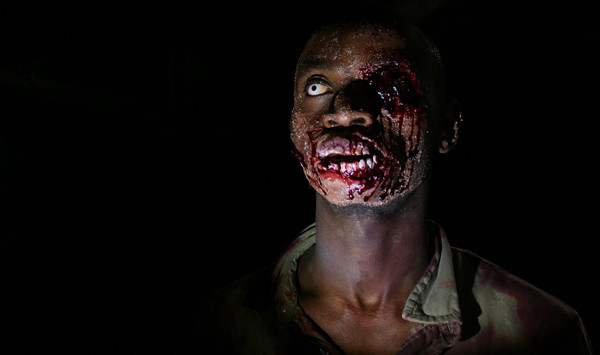
The Dead

Without doubt, the major game-changer here is the setting of Africa; the landscape is so at odds with the post-apocalyptic, claustrophobic urban environment seen in so much zombie-media in the last thirty years and for this reason has been unjustly compared to the Resident Evil 5 game, which is also set in Africa. Resident Evil 5 has taken a series full of suspense and intrigue with a slow burning anticipation at its heart and turned it into a mindless, dull, explosion-fest. The Dead, adversely, takes a genre that, through the evolution of the 'fast zombie' has strayed from its suspenseful roots; this places itself firmly back there, complete with slow zombies and a well crafted, laboured suspense rather than cheap jumps and breakneck editing.

The Romero influenced slow zombies are complemented by the Leone influenced long takes and expansive landscape shots, with zombies slowly but inevitably filling that vast landscape. This technique allows the suspense to build constantly, to the point where the slightest setback (stalled car, jammed pistol, etc) can turn the threat from constantly steadily building to imminently present in a matter of seconds. It is this slow burning suspense, along with well crafted set-pieces that makes this film a very worthwhile contribution to the genre.

It lacks the blatant political allegory of the Romero films, yet in an acceptable way, never becoming pointless or apathetic. One of the worries I had about the African setting was the way relentless liberal academics (myself, unfortunately sometimes included in this category) would be poised to criticise a film with the central white protagonist in amongst the 'zombified' natives of Africa, yet having seen it, I believe the way the buddy relationship is handled along with the representations of tribesmen and local militia met along the way easily do enough to make some statements on humanity without relying on lazy and potentially offensive typecasts.

Interview with the Ford brothers and Rob Freeman

(As will very shortly become clear, this interview took place before Mike watched the film.)

First of all I haven't read anything about the film as I haven't seen it yet (see?) and I do like to go into films with as blank a slate as possible; especially when it has picked up quite a bit of buzz as this has since playing at Frightfest. So, my questions will be more about you guys and genre film in general.

Fast Zombies or slow Zombies; which have you chosen, why, and was this a lengthy discussion?

Howard: Definitely slow zombies! Not only was this how our inspirations such as Romero did it, but from a directing perspective it was also the best way to make the film more suspenseful as the fast running zombies force you to shoot an action sequence.

Did you have a premise and then added the zombies to that, or adversely did you think: zombies are cool, let's build a story around them?

At this point Jon pre-empts a later question going back to what initially lit the filmmaking fire in his belly; he explained:

"Seeing Dawn of The Dead at such a young age really made me want to be a filmmaker, so this script has been in the process of being made for a very long time."

Howard: We had always wanted to do a movie about a lone man in an unfamiliar landscape, but it was when shooting all kinds of TV commercials in Africa that we discovered these un-tapped locations, and at the same time we were getting the feeling of having worked on commercials for so long and that this was paying the bills but just not fulfilling our dreams. Then a commercial for a well known brand of nappies tipped us over the edge and Jon said "we have to do this Zombie film now".
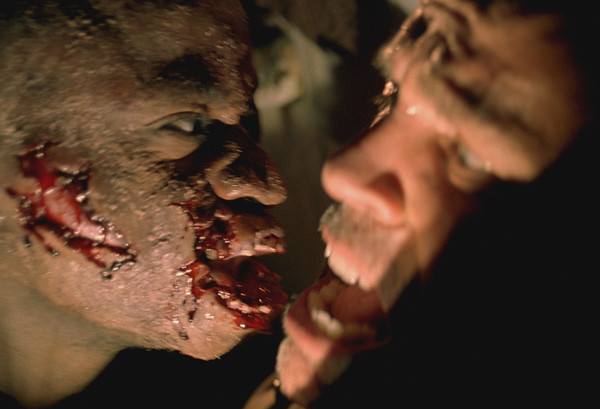
The Dead

How has current momentum behind zombie media helped? For the last ten years, starting with the original Resident Evil games, coming right up to the present with the TV show, The Walking Dead, zombies have been an increasingly successful commodity. Even specifically in Britain, we have had Dead Set, 28 Days Later and Shaun of the Dead.

Howard: It was 28 Days Later more than anything else, that enabled the Z-word to be used in pitching or trying to establish partnerships, even though 28 Days Later doesn't technically feature 'zombies'. This and Shaun of the Dead had done so well financially that it gave people confidence in the genre again. We had wanted to do a zombie movie since teenagers but the time had to be right if it was to work. I then went to my accountant to tell him about the idea, thinking he would laugh me out the window but not at all, in fact he offered to match my finance pound for pound and became an executive producer!

How have your journeys to get here been?

Rob came in at this point to reveal the extent of Howard & Jon's passion as filmmakers – he is visibly impressed with the filmmaking brothers after hearing their stories.

"When they were young, they would never go out and spend money on having a social life; they would save up and buy film equipment, going out all night shooting short films rather than going out on the town."

Co credits – what is the situation here? It always interests me when filmmakers make a point of pluralising the creators like Powell and Pressburger.

Howard: We have been compared to the Coen brothers – and embarrassingly, the Scott Brothers - but that's just the way it is. I have been directing and Jon as DOP through three features and well over 100 commercials and this is the way it usually works. Yet with The Dead, Jon had been so heavily involved with the script and initial concept it was only right that he had the chance to co-direct. However, as we got going, the reality of the tough shoot in Africa meant that Jon had enough responsibilities as a DOP so mainly we slipped back into our usual roles with me directing, but at the same time we were both as involved and invested.

Rob, how and when did you get involved?

Rob explained that he was taking a break from acting over in the states and came over to England to do some inline skating, a personal hobby. He met a girl who knew the Fords, and acquaintances were made. When it was time to start putting this zombie film together, Howard and Jon instantly thought of Rob. Howard remarked that

"probably no other actor could have survived the shoot as Rob is a fitness fanatic and this was one hell of a tough ride"

and anyway, his piercing blue eyes were essential to the role.
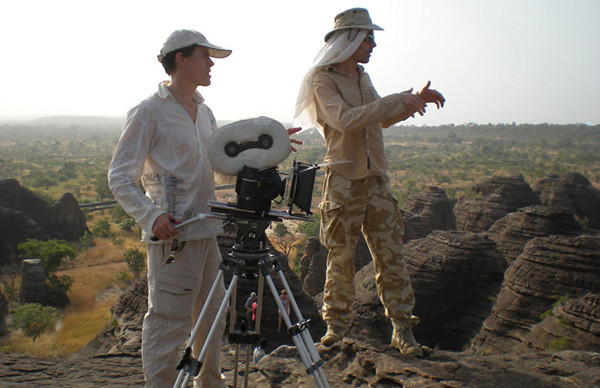
The Ford brothers on location

We spoke about their experiences on the shoot.

Howard: Rob got malaria and even features in The Dead whilst almost dead for real; "three days from death" as the doctor had told us at one point. For a shot in the film where his character Murphy has a fever, [Rob] had been wheeled out of the hospital, had his drip taken out and shot it right there whilst still delirious.

Howard reveals that he was mugged at knifepoint on their first day in the West African city where they would start their journey. Because his licence was taken, the production had to pay the police to keep him out of jail.

"We would have money extracted from us constantly, a lot of the time this was by armed police. We also had to wait five weeks to get all of our gear out of the ports there and when sufficient money had been parted with to get it in, some of it had been damaged and some of the prosthetic props had even melted in the heat."

Jon: Having come so close to death many times during the shoot, I still sometimes wake up in the middle of the night in a sweat, thinking I am stuck back out in Africa on location. A big part of me wanted to go home the moment I arrived, but luckily Howard persuaded me to stay.

Rob: I felt that something strange had been going on. I and many others felt that we may never get back home.

Howard: Although it was an incredibly harrowing experience, the African people in the villages that we encountered were fantastic and even though they hadn't even seen cameras before they agreed to become involved in the film, often acting as zombies or survivors. We all remain grateful for the people allowing us to film in their homes and villages and hopefully adding to the unique appeal of the film.

Come and watch The Dead on Friday night and decide for yourself - don't forget to let us know what you think.

Visit the official The Dead movie website

Mike McKenny is a Bradford based academic and film writer. He writes for Film & Festivals magazine, contributes to Hope Lies at 24 Frames Per Second and is the editor of Destroy Apathy. He can also be found on Twitter (@destroyapathy).

07 June, 2010

Michael Armstrong on David Bowie & Hanger Attacks: FFW2010 Day 2

On Saturday afternoon at FFW2010, the Screentalk with Michael Armstrong was preceded by a screening of The Image, which stars a young David Bowie in his first role. In this video clip, Michael talks about his working relationship with David, and how the filming was beset with difficulties.

The writer-director in our midst is a prolific and eloquent story teller -- indeed, the ‘conversation’ was almost a monologue -- and I was genuinely fascinated by what he had to say.

When asked about his influences, Michael told us he was enamoured with fairytales, folklore and mythology from an early age. He believes that “the only carnal sin [in art] is to bore.”

Michael was fervent on the issues of actor training -- “Acting is a craft, as skill… [a part] is not something [actors] can ‘make they’re own’” -- and the screenwriting business today -- “They now start the screenplay with the merchandising” -- neither of which received high praise from a man who is well-versed in both.

The decline of the British Film Industry during the 1970s, combined with the Eady Levy tax on box office receipts, meant that British films needed to fill a quota, so new production companies were given opportunities, and “horror was their best bet…independents gave opportunities to young film-makers, which was a very exciting time.”

Today, however, “[the film industry] is very nepotistic and based on networking…it’s like television, it’s very cliquey, and if you’re not part of the clique you’re an outsider.”

“The problem in the UK has always been investment, and that falls on producers. The good ones go to America. We lack film-thinking, creative producers based in the UK.”

Michael told the story of the making of Mark of the Devil, which had some audience members crying out with laughter. The original script included some ghastly character names amidst an unnecessary proliferation of S&M torture scenes and unintentional plot metamorphosis. On top of which, the filming in Germany with translators gone AWOL meant that it was a real Tower of Babel production.

Perhaps surprisingly, Michael describes himself as a very anti-violent man. His aim in making Mark of the Devil was to “make people feel sick…to show the crassness and unpleasantness… One tends for a comfortable life to put these things aside… This film shows the cruelty of what man is doing to man.” He told us about screenings of the film in America, which were accompanied by nurses waiting to attend to fainters, and vacated auditoriums smelling of vomit.

So I wasn’t going to stick around for the film itself, and decided instead to go and watch the zombie-tastic 28 Weeks Later. I asked our resident horror expert, Sarah, what she had managed to watch that day amidst all the hobnobbing.

First film of the day for Sarah was The Giant Spider Invasion, which was “very kitsch, got big laughs, and was a good warm-up for Birdemic…a giant furry spider on wheels with some horrendous acting.”

Sarah attended the two director-accompanied films on Saturday evening: David Gregory’s Plague Town, and James Nguyen’s Birdemic. Both guests were affable in the bar before and after the films, staying to chat and discuss their offerings with FFW attendees.

“David was a guest at the Museum ten years ago when he brought a double bill of Texas Chainsaw Massacre and The Last House on the Left, so it was like welcoming an old friend. The film had some spectacularly creepy touches – he has clearly learned from the masters throughout his career as horror documentary film-maker.”

Birdemic was, by all accounts, the star of the show but for all the wrong reasons. Audience members were inexplicably given coat-hangers on their way in, which was clarified when characters attempted to fight off killer birds with this as their chosen weapon. It certainly invited some great audience interaction in the style of Rocky Horror.

Sarah tells me there were cheers and howls of laughter, however the director absolutely believes it’s a romantic thriller and is quite surprised it’s been taken on at horror festivals. He is currently in talks with Hollywood about doing a sequel, which he hopes to bring to our screens in 3-D! You heard it here first.

Day 3 is the next and final blog about the Fantastic Films Weekend. Look out for a video clip of Stanley Long’s Screentalk, and closing reviews from Sarah, and the Festival’s Artistic Director, Tony Earnshaw.

If you want to hear more from Michael Armstrong, please visit the National Media Museum podcasts page, where you can listen to or download an audio podcast of the event.

06 June, 2010

Fantasy in Academia & Lizard in a Woman’s Skin: FFW2010 Day 1

A 60°F June morning was a far from allegorical setting for the launch of the 9th Fantastic Films Weekend on Friday, but nevertheless, here we are on the last day of what has been a great weekend with some fantastic turn-outs for our film selections.

I only managed to make it to a splattering of events, but I had resident horror fan and dedicated FFW attendee Sarah Crowther acting as reconnoiter – more from Sarah later.

The main event on Friday was the Fantasma symposium of speakers discussing everything from Italian Horror to British Sex Films. Mark Goodall from Bradford University introduced the event which he organised in partnership with the National Media Museum, due to the recognition of a growing community interested in and treating the subject seriously.

First up was Ian Hunter, who talked on the subject of British Sex Films – an apt subject as we welcomed veteran director of said genre, Stanley Long, to FFW2010 earlier on today. Despite once being described as having “no redeeming features whatsoever”, Hunter pointed to the genre’s importance, as it was sex films which propped up the British film industry during its collapse in the 1970s.

Ian talked us through the key genres, and showed how, like horror films, they responded to changing social trends, for example, the emerging discourse of a consumerist attitude toward sex, and how they often played out a conflict between an older repressed, and younger permissive generations.

From the carnal to the incorporeal, the next guest was David Robinson talking on his paper The Infected Idyll: The Living Dead at Manchester Morgue, a film which is showing tonight.

David spoke about the film in terms of the cultural anxieties of the age, all of which are hinted at in the “crass juxtaposition” of the opening scene, and concluded with a reading of the film which posits an enduring conflict between urban and rural. The film although set in England, is European, and is evidently worth seeing for the confused geography and variety of regional accents alone!

I ducked out just before Russ Hunter took centre stage with his whistle stop tour of Italian horror films, which I’m not sorry I missed since he had apparently chosen some particularly gory clips to entertain us with just before lunch! I also missed Gail-Nina Anderson’s Dracula’s Cape. But not to worry – all the talks will be available as podcasts to listen to or download from our podcasts page on Wednesday.

Last speaker of the day, and star of the event in my book, was Jeremy Dyson. I’m only really familiar with Dyson’s work on The League of Gentlemen, as I’m sure most of you are, but what a sweet-natured and engaging man he is!

In Shadows and Fog, Jeremy considered the feelings evoked by watching horror and fantasy cinema from childhood, and explored the question of how terror sensations are created within cinema and television productions, when they are often so difficult to articulate. What is it that makes I Walked With a Zombie chill-inducing, while LOTR: The Return of the King leaves him cold? Obviously the answer doesn’t lie with special effects and a huge budget, instead “what you need to get this sensation is a space between what’s being shown and what’s being represented.”

Dyson took some questions from the crowd, and the use of CGI came up on more than one occasion. On this subject, Dyson was enthusiastic.

“I think we’re living in amazing times. It has to be looked back on as a golden age…we have incredible resources, but you can be swamped with choice. This is the challenge now, how you navigate that [choice]. It would be foolish to be luddite about it.”

Fantasma concluded with a screening of Secret Rites, and this was only one of a few films on offer on Friday, as the symposium was the focus for Day 1. I asked our resident horror geek, about what she had seen, and Giallo being Sarah’s favourite genre, top of the list was always going to be Lizard in a Woman’s Skin.

“Lizard in a Woman's Skin is the film that nearly caused the incarceration of its director, Lucio Fulci. The notorious director only escaped jail time thanks to the testimony of his special effects artists who produced the mannequins of the film's gore-soaked dead dogs that the court had believed to be real. Ironically, Lizard is one of Fulci's less visceral films, instead a psychadelic trip into giallo as a woman struggles to separate dream and reality following a gruesome murder. A busy house at the Museum certainly enjoyed the Festival's first foray into Fulci - and can look out for more from the horror maestro at future fests.”

More fantastic films in the next post, along with a video clip of the scintillating screentalk from Michael Armstrong.

Don’t forget that podcasts of all the talks will be available on the National Media Museum’s podcasts page from Wednesday, and are yours to download and listen to at your leisure.

27 May, 2010

Feel the Fear at the 9th Fantastic Films Weekend

The weather has been sunshiny and bright here in Bradford this week, but next weekend at the National Media Museum, things are about to get a little darker…

From Friday 4 June – Sunday 6 June 2010, we open our doors to the world of horror, sci-fi and fantasy cinema in all its gory-ous detail for the ninth year running.


The Fantastic Films Weekend began in 2002 and has evolved into “the cult cinema festival to go to” (The Box of Obfuscation), showcasing a line-up of classic chillers, sci-fi shockers, fantasy epics, vintage TV shows and rarely seen gems from the vaults.

Highlights include a midnight screening of Birdemic, which will be attended by the film’s director, James Nguyen – described as the new Ed Wood – I hear this is a real shocker! We will also be welcoming David Gregory, a familiar name in horror circles who has produced countless documentaries on the genre. Gregory is in town to present his first feature, Plague Town.

Don’t miss an appearance by the multi-talented but elusive Jeremy (The League of Gentlemen) Dyson, who will be joined by other guest speakers at Fantasma, a one-day symposium created in partnership with Timecode – Bradford University’s media seminar series.

We will be taking a look at the horror ‘ones to watch’ in the FFW2010 Shorts selection, alongside rarely seen classics such as The Living Dead at Manchester Morgue, Lizard in a Woman’s Skin and Screamtime, and perennial favourites Psycho, Horror Express and Videodrome.

We will be blogging and tweeting in the run-up to and throughout FFW2010, and would love to hear from you. Add your comments to this blog or tweet using the hashtag #FFW2010.

You can also check out our FFW2010 Facebook page for updates, watch film clips and footage from the event on the National Media Museum’s YouTube page, and view pictures from this year and festivals past, by visiting the National Media Museum on Flickr.

For further details and to buy tickets, come on in and explore the Fantastic Films Weekend 2010 website. I dare you…

17 June, 2009

And now the screaming stops...


After three days, 31 films, six TV shows, two zombie film costumes and one glowing review in The Guardian, Fantastic Films Weekend drew to a close on Sunday night.

Artistic director and FFW overlord Tony Earnshaw looked tired but happy by the end of our 8th horror and sci-fi filmfest-- you can read his thoughts on the weekend over at our dedicated Fantastic Films Weekend site.

As Tony says, the busiest and best-received films were the mighty Aliens in 70mm (for which we had more audience laughter at Hudson's panic attacks than we -- and one disgruntled Twitterer -- bargained for); the low-budget The Scar Crow, which most attendees agreed punches well above its weight; and The Disappeared. Our special screening of silent classic Vampyr, with specially-composed live accompaniment from Harmonieband, was packed, as was the screening of 1932's Dr Jekyll And Mr Hyde.

And of course there was Mike "Flash Gordon" Hodges' fascinating screentalk on Sunday night -- which you'll be able to hear in full on our podcasts page shortly.

As for me, I was hectically rushing about grabbing photos of the event (see our Flickr page), and handing out the special "Twitter/Facebook/Flickr us!" minicards we designed and printed specially for the weekend. I unexpectedly ended up on stage before several of the films, dwarfed by the six-foot high Twitter hashtag (#ffw09) being beamed onto the cinema screens behind me. It was gratifying to see all that translate into some lively FFW discussion on Twitter.

But we didn't need Twitter to appreciate what a great community of horror and sci-fi lovers we have, many of whom bought passes for the entire weekend, and all of whom seemed to leave with happy faces (and tweets). Thanks to everyone who came along.